10. PREFUSE 73 – ONE WORD EXTINGUISHER WARP105 (2003)

Rattling through 23 tracks of glitchy breakbeats, chopped-up vocals, squelchy synths and even some glorious jazz bass and Rhodes on Uprock and Invigorate in just 60 minutes could have resulted in a car crash of an album in less capable hands than producer Scott Heren. Somehow One Word Extinguisher manages to hang together as a raw but coherent album despite its constant shifts in mood and style from the in-your-face hip-hop of The End of Biters - International through the melancholic electronica of 90% of My Mind Is With You to the soulful beats of Why I Love You and the optimistic synth drone of album highlight Choking You. This unexpected coherence may be the result of the year-long relationship breakup that accompanied the recording of the album, but what results is an album ahead of its time -it predicted many of underground hip-hop’s movements later in the decade.
9. BATTLES – MIRRORED WARP156 (2007)

Anyone who’s seen Battles live knows it’s all about the energy and intensity of drummer John Stanier and his unusually high cymbal followed closely by guitarist/keyboardist Ian Williams. They may have lost vocalist Tyondai Braxton in 2011, but how many identifiable words are to be found on Mirrored anyway, despite the numerous ahs, whistles and hums? Musically Battles’ first full-length record, has been categorized as math rock due to its complex stop-start atypical rhythms and angular dissonant guitars, but thanks partly to its release on Warp and partly to the dancefloor-friendly tribal rhythms of single Atlas it has crossed over the dance/indie divide. Race: In starts the album off sounding similar to the post-rock of Tortoise, but quickly moves into far less familiar musical territory with the elephant-like noises of Atlas and juxtaposed speed-vocals and whistling of Ddiamondd. Leyendecker (named after the Leyendeckerstrasse subway station in Cologne) offers one of Mirrored’s more restrained and catchier moments, with its killer jerky beat and wailing vocal noises, before Race: Out brings things full circle and creates an eternal loop: the album’s end “mirroring” its beginning, so producing a fittingly postmodern climax.
8. POLYGON WINDOW – SURFING ON SINE WAVES WARP7 (1993)

The fact that Aphex Twin’s first album for Warp was released under the pseudonym Polygon Window allows me to include two Richard James albums in my top twenty. Surfing on Sine Waves, second in the (Artificial Intelligence) series, is a dark, twisted album that draws equal inspiration from the Stockhausen-influenced European electronic tradition embodied by Kraftwerk as well as the funkier sounds of Atkins, May and Saunderson’s Detroit techno. Synth melodies build, interweave and decay over the beautiful brutality of the relentless thumping Roland kick drum, only letting up on final ambient track Quino-phec. The monochrome artwork perfectly captures the brooding atmosphere of loneliness and isolation that pervades the album: an agoraphobic front cover of Cornish cliffs and sea, a claustrophobic inner sleeve of Richard D. James rushing down subway steps and an enigmatic back cover showing a mysterious lone figure surfing. This album represents the triumph of machines over nature, with any human elements used only sparingly to add texture, such as the “Do-Re-Mi” sample from the Sound of Music on Supremacy II. Deemed (mistakenly) by some critics as a mere diversion in the Aphex catalogue, this album still disorientates18 years after it first appeared, no more so than on single Quoth, a drum-driven frenzy cooked up in Kernow.

Saint Dymphna is a complex album of contradictions to be filed under mainstream avant-garde. Opener Bebey lulls its listeners into accepting a cold, futuristic, machine-like atmosphere through woozy synths, sharp hi-hats, reverb-drenched toms and cascading keyboards then abruptly takes an unexpected turn into a number of incongruous human elements in the more ancient sounds of African drumming and melodies filtered through a New York pop sensibility. First Communion then introduces the further contradiction of a singer who does not sing. Instead, vocalist Lizzi Bougatsos shrieks, wails and howls over choppy guitars and an eighties pop chorus. Vacuum breathes life into the corpse of My Bloody Valentine, overlaying the dense mass of guitars, keyboards and noise with the sound of laser guns before suddenly dropping into the Brooklyn arthouse glitter meets East London grime of Princes featuring Tinchy Stryder. Single House Jam offers post-punk attitude delivered with pure 80s pop melodies whilst comedown closer Dust is a Middle Eastern lullaby, gently rocking Saint Dymphna to tenth place in FACT Magazine’s 100 Best Albums of the 2000s.
6. GONJASUFI – A SUFI AND A KILLER WARP172 (2010)

“There’s a Sufi and a Killer in everybody, man, and I'll be whatever I have to be just to make it through", Californian yoga teacher Samuel Ecks told The Guardian newspaper ahead of his debut genre-hopping album release for Warp. Though extremely eclectic in its sources, this is not an easy listening album with the tension between Ecks’ sufi and killer sides being played out over 19 sprawling lo-fi hip hop tracks that take in Turkish psych, acid folk, psychedelic soul, funk and Hindi movies soundtracks all filtered through a vintage fuzzbox. Ecks’ voice is rough, raw and cracked, much like the the Mojave desert, a place he calls home at least part of the time. Gaslamp Killer provides much of the production on A Sufi and Killer, delighting dusty crate-diggers with such aural treats as the Eastern chants of Kowboys and Indians. Fellow LA producers Flying Lotus and Mainframe chip in too, the former with the trippy sitars of album highlight Ancestors, the latter with the p-funk of ultra limited edition 7”single Holidays/Candylane (with its gold foil printed prayer book upping the mystical ante). Ecks also does “normal” with a twist: gentle animal-themed ballads (Sheep) as well as standard songwriters’ emotions (like the pain of loss on She’s Gone) are present, but always permeated with the reassuring fug of a cheap microphone and a dusty needle.
5. HUDSON MOHAWKE – BUTTER WARP188 (2009)

Would anyone out there have this in their Warp top 20, let alone top 10? The critics certainly wouldn’t – Butter arrived in an audacious sleeve, but to modest reviews. I’m not sure there’s anyone out there who loves Hudson Mohawke’s debut LP as much as I do (although not as much as the genius of his Polyfolk Dance EP on Warp – the pinnacle of wonky). There is nothing subtle about Butter or its influences (prog rock, 80s hip-hop, p-funk, R’n’B, computer games) – from the screeching hair metal guitar of intro Shower Melody into the bump and bombast of Gluetooth, this is an over-the-top album caught in the act of veering dangerously out of control. Joy Fantastic sounds like a Glaswegian Outkast on acid, whilst 3:30 throws things off-kilter with Hudson Mo’s beloved dislocated beats and high-pitched chipmunk vocals that permeate many of the tracks on Butter. If I had even less sense, this ridiculous album would be my Warp all-time number one, but it’s a schizophrenic album with slightly too much tasteless R’n’B (fun as it is) and slightly too little wonky mayhem such as LP highlights No One Could Ever and FUSE.
4. APHEX TWIN – RICHARD D. JAMES ALBUM WARP43 (1996)
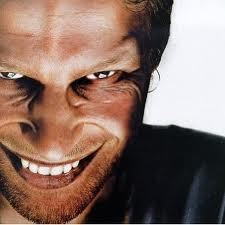
Back in the day the mark of a good album for me meant it could fit on one side of a C90 cassette. At under 33 minutes in length, you could almost squeeze RDJ Album onto one side of a C60, with such economy of size meaning every beat and every sound needs placing with great technical precision. RDJ Album starts abruptly with 4 - straight in with strings underpinned with drill-n-bass beats as there’s no time to waste on a gently building into – this feels like an album whose raison d’etre is simply to meet its end. This sense of the difficulty of capturing the present moment reflects the album’s central theme - the Cornwall of Aphex Twin’s childhood. Whether places (Carn Marth, Goon Gumpas) or ZX Spectrum code (Peek 824545201) these are Blakean Songs of Innocence and Experience as witnessed by the cover shot of the artist’s evil grin. Fleeting memories of lost innocence are painted with extreme clashing textures – Girl/Boy Song (track 3.5, second side) is a microcosm of the album’s tension between the “innocence” of lush classical strings and soothing childlike melodies on the one hand and the butal “experience” of the undanceable drum onslaught on the other. Pitchfork hailed RDJ Album as the 40th greatest album of the 1990s and its disorientating portrait of a lost Cornish childhood hasn’t faded with age.
3. BLACK DOG PRODUCTIONS – BYTES WARP8 (1993)

The third (and best) installment of the (Artificial Intelligence) series, Bytes is both a product of and a reaction against the four-to-the-floor rave culture that dominated UK dancefloors in the early 90s. This is an intelligent yet playful album, taking cold Detroit techno as its base, then adding a warmer palette of emotion and eccentricity to transform it into something distinctly British. The playful theme continues into the sleeve notes – Bytes is presented as a compilation of different artists (apparently for contractual reasons), but each is a combination of one or more of the three London producers Ed Handley and Andy Turner (Plaid) and Ken Downie. This pseudo-compilation structure allows Black Dog Productions to experiment, innovate and produce an album of great variety with the end-of-the night acid house of Caz (by Close Up Over) sitting unproblematically next to the “Massive Attack rhythm section” meets “Aphex Twin melodies and acid piano” of Carceres Ex Novum (by Xeper). Bytes is a highly influential album and an essential chapter in the development of electronic listening music – a must have for anyone who claims to like Warp.
2. BOARDS OF CANADA – MUSIC HAS THE RIGHT TO CHILDREN WARP55 (1998)

I have no idea if Michael Sandison and Marcus Eoin had children of their own when they recorded their debut for Warp (I suspect not), but this album is the sound of childhood through adult eyes and ears. How reliable are our early memories? Was childhood really so carefree and innocent? The hazy cover shot adds to the confusion: a “family” scene depicting three adults and four children, faces removed for anonymity. But why three adults in a family scene and faces removed to protect whom? The theme of anxious nostalgia also plays out in the band’s name (taken from National Film Board of Canada) and the album’s warm 70s drenched analogue mood also appears to draw on the incidental music that would have backed these fondly (if not accurately) remembered public information films. There are standout tracks (the distant voices and fragile melodies of Turquoise Hexagon Sun; the slow squelchy krautrock of Roygbiv), but this album’s greatness is down to its homogeneity with every track and interlude playing an equally important role in delivering one of the most influential British albums of the nineties. Ranking this “pioneering collection of pastoral folktronica” at #35 in their top 100 albums of the 1990s, Pitchfork perfectly sums up Music Has the Right to Children’s considerable legacy and why the name “Boards of Canada” could just as easily refer to the whole genre of music they spawned: “Sometimes an album is so good and makes its case so flawlessly that it spawns a mini-genre of its own and becomes shorthand for a prescribed set of values”.
1. FLYING LOTUS - COSMOGRAMMA WARP195 (2010)

It may not have won him the Grammy he thought it deserved, but this is still an “important” album. Like Boards of Canada, Steve Ellison has succeeded in creating his own personal mini-genre complete with its own private mythology and symbolism, in this case the self-described “space opera”. Building on his previous album Los Angeles (another Warp classic), Cosmogramma is denser, more multi-layered (yet more coherent), has more live instrumentation and more obvious jazz influences. Like fellow visionary and astral traveller, William Blake, Ellison’s creation involves a revolution of the imagination: “I must create a system, or be enslaved by another man’s” in Blakean terms. In Cosmogramma’s case this meant freeing Flying Lotus from every limiting genre “box” he’d ever been put into and allowing his creative energy to expand into new territories of sonic innovation. Thus Los Angeles’ insular post-Dilla urban travelogue is transformed into one complete otherworldly musical movement built around several distinct passages that vary in intensity and mood to provide an absorbing electronic-organic listening experience. After the jolting full-on introduction of Clock Catcher, Pickled! and Nose Art, the electronic computer game noises of this opening three-track passage suddenly decay into the organic celestial harp and subtle orchestral sweeps of Intro//A Cosmic Drama and Zodiac Shit, invoking the spirit of Ellison’s aunt (and my favourite jazz artist), the late great jazz multi-instrumentalist Alice Coltrane. This passage continues on into the soulful Computer Face//Pure Being, album highpoint …And the World Laughs With You, featuring subtle low key vocals from Thom Yorke, and the saxophone, harp and strings of Arkestry. After the Charles Stepney-like interlude Mmmhmm, Do the Astral Plane introduces a mid-tempo 4/4 house beat to the proceedings, only for Satelllliiiiiteee to take things off the dancefloor and back into more warped listening territory. German Haircut opens a closing passage of more downtempo jazz whose beautiful bleeps, violins and harp explicitly reference Alice Coltrane on Drips//Auntie’s Harp - highly appropriate given the album was named after Ellison misheard the term “cosmic drama” on one of her recorded discourses. Waiting for a Kenya Airlines flight to Nairobi at Heathrow Terminal 3 in May 2010, I immediately felt a sense of aural superiority to all others passengers due to the privilege of hearing the just-released Cosmogramma for the first ever time. Whilst the critical jury is still out, it is the sheer level of musical imagination and ambition packed into the 17 tracks that makes this (for me) the greatest Warp album of the first twenty years.


